The Medieval Combat Society |
|
|
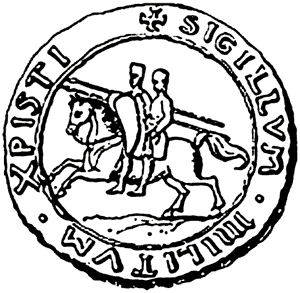
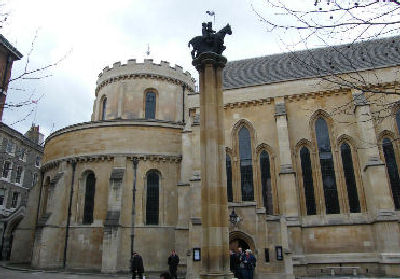
Founding of the OrderIn 1118 or 1119 Hugues de Payens and his relative Godfrey de Saint-Omer asked King Baldwin II of Jerusalem to form a monastic order to ensure the safety of Christians who made pilgrimages to Jerusalem following its capture in the first crusade. King Baldwin granted them space in the Al Aqsa Mosque, which was believed to have been built on the ruins of the Temple of Solomon, and therefore gained the name Solomon's Temple. From this the order became the Poor Knights of Christ and the Temple of Solomon. The order had humble beginnings and started with just 9 nights, and relied on donations, there emblem is two knights sharing a horse. Individual members were sworn to an oath of poverty. Saint Bernard of Clairvaux who was a nephew of one of the founding knights spoke and wrote on their behalf and in 1129 The Order was officially endorsed by the Roman Catholic Church at the Council of Troyes. This allowed them to become a favored charity throughout Europe. In 1139 Pope Innocent II issued the papal bull Omne Datum Optimum which exempted the order from being subject to local laws and taxes, allowing them free passage and were only under the authority of the Pope. Templar CodeThe order was based on the Cistercians and devised a code of behaviour known today as the Latin Rule with 72 clauses, which determined how many horses they could have, what they could wear, to take their meals in silence and to not eat meat more than 3 times a week. Over time the number of clauses increased to over several hundred. |
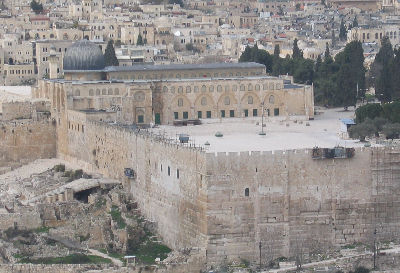
Al Aqsa Mosque, Israel, where the Knights Templar were given space, also thought to be the site of the Temple of Solomon Temple Church, London, showing image of two knights sharing a horse |
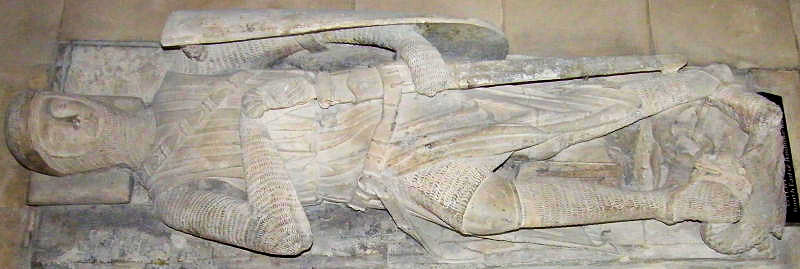
Gilbert Marshal 4th Earl of Pembroke 1241 , Temple Church, London, the effigies were badly damaged by WWII bombing
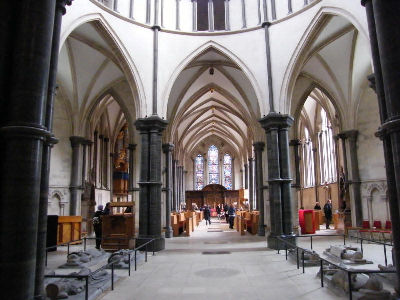
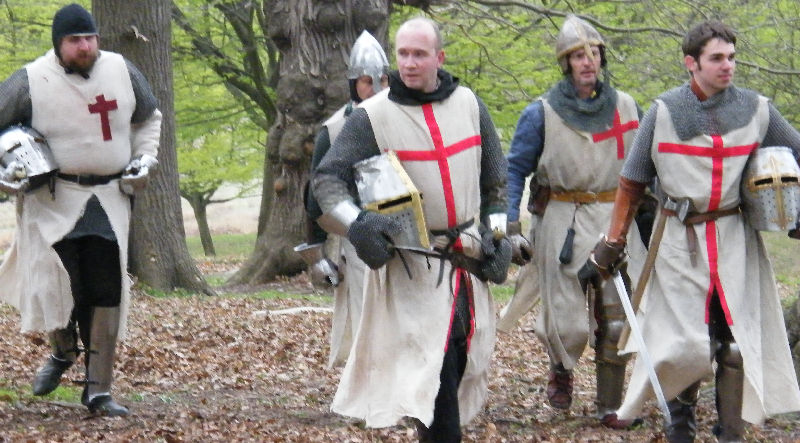
Medieval Combat Society filming for documentary on Templar's Interior view, Temple Church, London |
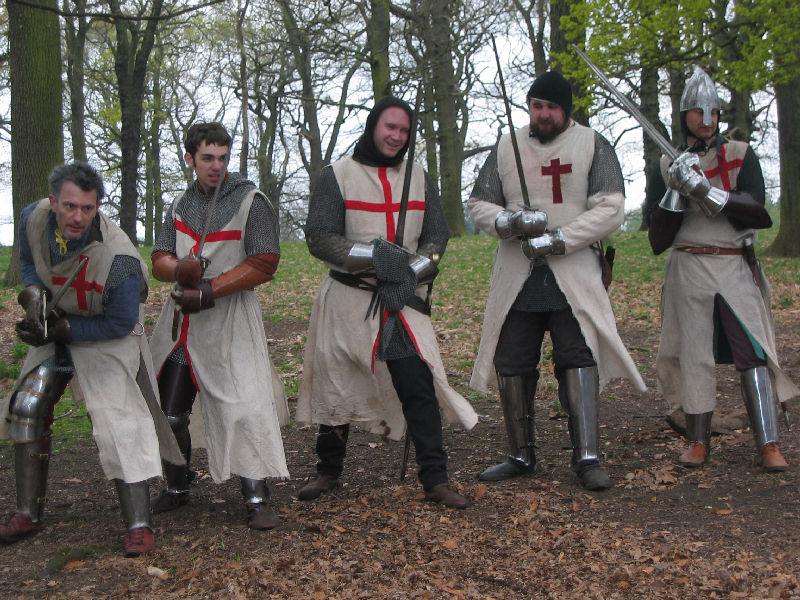
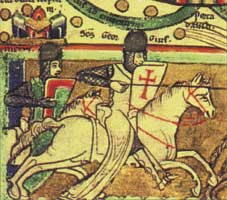
Knights TemplarKnights of the order wore white mantles, assigned to the Templars in 1129 at the Council of Troyes and surcoats quartered by a red cross, a symbol of martyrdom, probably added at the start of the Second Crusade in 1147, and were heavily armoured knights from the aristocracy with war horses. Knights had to wear their white mantles as all times, even when eating and drinking. Knights of the Order would never surrender unless the Templar flag had fallen, and even then they should try and regroup with other Christian orders. They had a solemn initiation ceremony that outsiders were discouraged from attending that was to later cause mistrust in the order. New members generally joined for life, and had to willingly hand over their wealth and goods to the order and took vows of poverty, chastity, piety and obedience. Married men could join if they had their wives permission but they were not allowed to wear the white mantle, and occasionally knights were allowed to join for set periods of time. Below the knights were sergeants who wore a black surcoat with a red cross and a black or brown mantle, and were lightly quipped cavalry. Chaplin's were ordained priests who looked after Templar spiritual requirements. Other members looked after its infrastructure which grew rapidly to large proportions, mainly through gifts of land from wealthy benefactors. They used their finances to build castles and fortifications throughout the Mediterranean and Holy Land, and to purchase further lands, farms, vineyards. They were involved in manufacturing, import and export and even had their own fleet of ships. With this military strength, financial stability and their large wealth, the Templars developed a banking system in 1150 to ensure the safe transfer of money, by using encoded documents to note deposits of wealth the documents could be used to retrieve funds at the destination of travelers, making them less susceptible to robbery. |

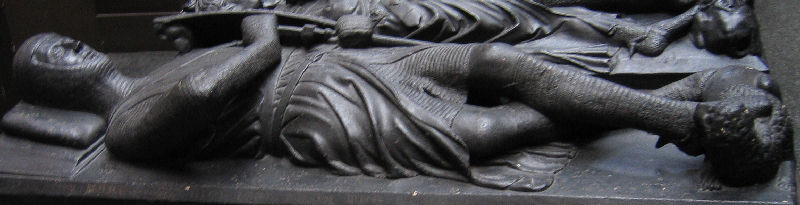
William Marshal, 1219 cast at the Victoria and Albert Museum taken from Temple Church, London
Order loses its purposeIn the mid 12th Century the Muslims started to unite and the Christian factions had internal fighting which weakened their positions. Two other Christian orders the Knights Hospitaller and Teutonic Knights were at times at odds with the Order. In 1185 the Patriach of Jerusalem, Heraclius visited England and consecrated the Temple Church in London, it is thought that his aim was to gain support and unite the Christians. In 1172 king Henry II had vowed to take the cross and go on a crusade. Henry II summoned a Great Council at Clerkenwell and gave Heraclius his answer: 'for the good of his realm and the salvation of his own soul' he declared that he must stay in England. He would provide money instead. Heraclius was unimpressed: 'We seek a man even without money - but not money without a man.' Virum appetimus qui pecunia indigeat, non pecuniam quae viro. Finally Jerusalem fell in 1187, was retaken in 1229 but fell again in 1244. The Templars set up headquarters in Acre, but that fell to in 1291, their strongholds of Tortosa and Atlit fell later, and the Order set up their new headquarters at Liassol on Cyprus. The Order did manage to keep a foothold on the island of Arwad but this finally fell in around 1302 to 1303. When the holy land was lost, they maintained their European possessions, but their original purpose had gone. Pope Clement V in 1305 wanted to discuss merging the Order of the Temple with the Hospitaller's, but neither the Templar Grand Master Jacques Molay or the Hospitaller Grand Master Fulk de Villaret wanted this to happen. However in 1306 the Pope summoned them both to discuss the idea in 1307. Charges of Heresy raised by a Templar who left the Order in 1305 were discussed by Jacques Molay and Pope Clement V and agreed to be unfounded, but Clement asked King Philip IV of France for help in investigating the charges. |
Templar Seal showing horse carrying two knights
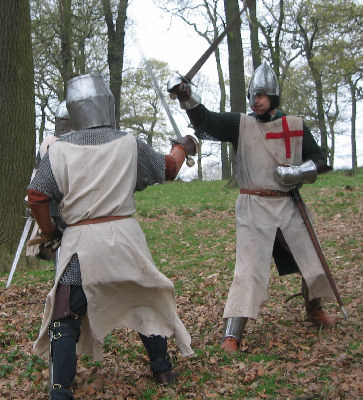
Medieval Combat Society filming for documentary on Templars |

William Marshal the Younger, 1231 cast at the Victoria and Albert Museum taken from the Temple Church London
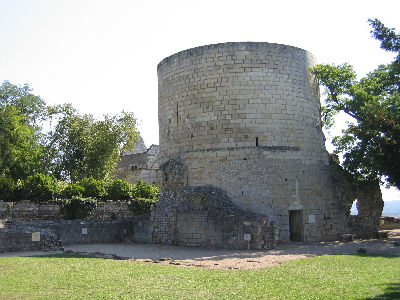
Donjon du Coudray, Chinon, where some of the Templar leaders were held including Jacques De Molay
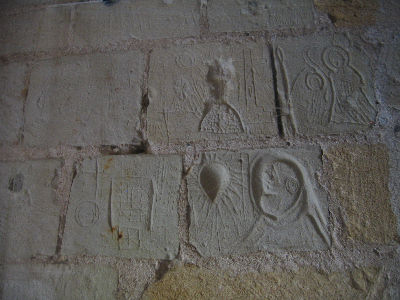
Templar carvings at the Donjon du Coudray, Chinon
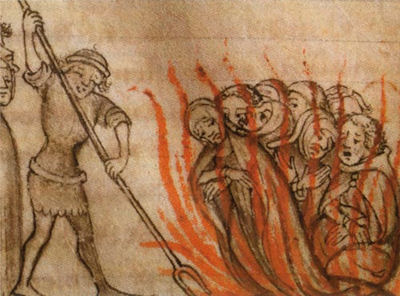
Templars being burnt alive |
Arrest of the TemplarsKing Philip IV of France was deeply in debt to the Templars and on Friday 13th October 1307 accused them of heresy and had them arrested in France. Many were tortured to obtain confessions of heresy. This was a way to avoid paying back debts, and by confiscating further Templar assets Philip was able to make further money. Pope Clement under pressure from King Philip, then issued the bull Pastoralis Praeeminentiae on November 22, 1307, instructing all Christian monarchs in Europe to arrest all Templars and seize their assets. Pope Clement called for hearings run by the papacy to try members of the order, and may withdrew their confessions given under torture. It was normal practice at that time to burn stake anyone who recanted their confessions of heresy as relapsed heretics, and when the Templars did so Philip had many burnt in Paris to force the proceedings along. A document found in the papal archives in 2001 known as the Chinon Parchment and records the papal trials showing that Pope Clement absolved the Templars of all heresies in 1308. King Philip applied pressure to Pope Clement, even threatening military action and Pope Clement finally disbanded the order in 1312 at the Council of Vienne with the papal bull Vox in excelsior and the papal bull Ad providam which turned over the majority of the Orders assets to the Hospitallers. Jacques de Molay the grand Master of the Order and Geoffrey de Charney the Preceptor of Normandy both retracted their statements and declared guilty of being relapsed heretics. Both were burnt to death in Paris on 18th March 1314. Jacques de Molay is reported to have said that both Pope Clement and king Philip would soon meet him before God. Pope Clement died a month later, and before the end of the year king Philip died in a hunting accident. The remainder of the Templars were either arrested and tried or absorbed into other military orders such as the Hospitaller, or allowed to live their lives out peacefully. Some fled to other countries, and in Portugal the Order changed their name to Knights of Christ. Many sites today are related to Templar sites such as Temple Bar in London, Cressing Temple in Essex, and Templecombe in Somerset. Some societies today such as some Freemasonry groups use symbols of the Order or claim links to the Order. Much controversy has been caused over the allegations of heresy, and links to the holy grail. The Turin should thought to be a fake made between 1260 and 1390 was first publicly displayed in 1357 by the grandson of Geoffrey de Charney. |
Medieval Combat Society filming for documentary on Templars
Order of the Temple Grand Masters
|
Knights Templar |
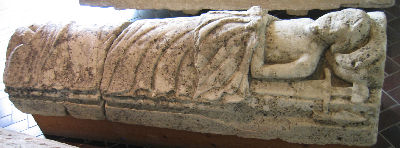
13th Century Templar effigy from the La Roche Commandery, now in the Poitiers Museum |
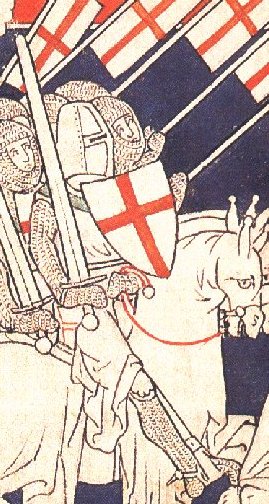
Knight Templar on warhorse with shield and spear |
Timeline of the Order of the Temple1099 First crusade captures Jerusalem |
|
Home •
|